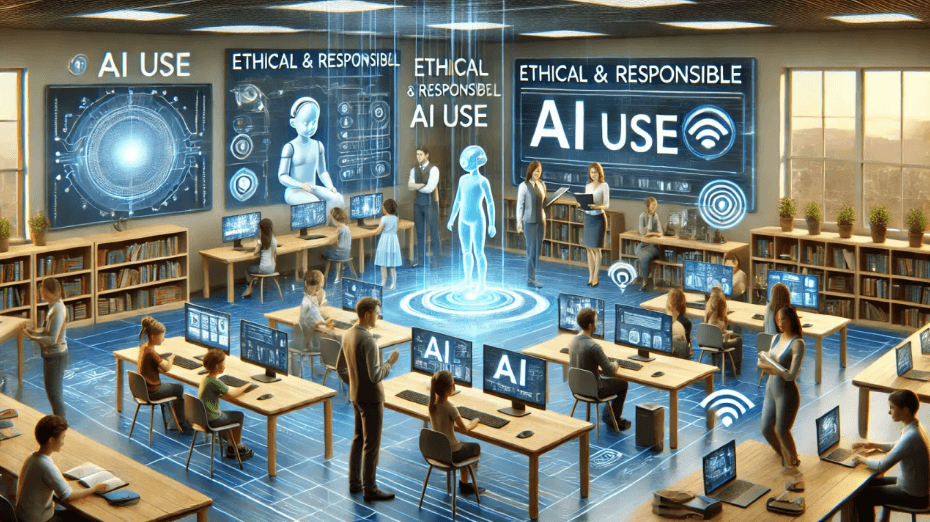
Schools have faced major technological transitions before. Calculators changed mathematics instruction, computers transformed research and writing, and internet access gave students information far beyond what could fit inside a school library. Artificial intelligence represents another significant transition, but its ability to generate text, images, explanations, and other content creates questions that previous classroom technologies did not always raise.
School leaders now have to consider when AI should be permitted, how teachers can use it, what students need to know about it, and how academic expectations should change. Simply allowing every use or banning the technology entirely may overlook important realities. A more sustainable approach involves establishing clear expectations, protecting student information, supporting teachers, and periodically updating policies as the technology evolves.
Policies Should Define Acceptable Use Clearly
Students need to know what is expected before they can be held accountable for violating those expectations. A rule that simply says “do not misuse AI” leaves considerable room for interpretation.
Policies governing AI in schools can distinguish between activities that may be acceptable and those that interfere with the purpose of an assignment. A teacher might permit students to use an AI tool for brainstorming but require the final writing to be completed independently. Another assignment might allow AI-assisted research while requiring students to verify every factual claim with approved sources.
Some assessments may prohibit AI entirely because the teacher needs to evaluate what the student can do independently.
These differences make assignment-level guidance important. A schoolwide policy can establish broad principles, while teachers provide specific instructions based on the learning objectives of individual courses and assignments.
Students should also know how to acknowledge permitted AI assistance when required. Clear disclosure expectations reduce uncertainty about whether using a tool crosses an academic integrity boundary.
Teachers Need Support Alongside Students
Educators cannot be expected to manage a rapidly changing technology without training and institutional support.
Professional development can help teachers understand what generative AI can and cannot do. Educators may benefit from experimenting with tools themselves so they can recognize both useful applications and common limitations.
Training can also address classroom-specific questions. Teachers need strategies for designing assignments, discussing responsible use, evaluating student work, and responding when inappropriate AI use is suspected.
This does not mean every educator must incorporate artificial intelligence into every subject. Teachers should be able to determine when a technology supports their instructional goals and when traditional methods are more appropriate.
Collaboration can make that decision easier. Departments can share examples of successful assignments, discuss challenges, and develop consistent expectations for similar courses.
Schools may also want a designated group responsible for reviewing AI developments and communicating important changes. Without coordination, teachers can end up creating entirely different rules with little guidance about broader institutional priorities.
Academic Integrity Requires More Than Detection
Generative AI has created understandable concerns about students submitting work they did not produce themselves. Schools need ways to address those situations, but relying entirely on automated detection can create additional problems.
Instead, assignment design can become part of the response.
Teachers may ask students to submit outlines, drafts, notes, source evaluations, or reflections that demonstrate how their thinking developed. Classroom discussions and short oral explanations can also give educators insight into whether students understand what they submitted.
Assignments tied to class discussions, local examples, experiments, personal observations, or specific source materials may require more genuine engagement than generic prompts that can be answered without participating in the course.
This does not make inappropriate AI use impossible. It does, however, shift attention toward the learning process instead of treating every assignment as a final document detached from how it was created.
Schools should also establish fair procedures for addressing suspected violations. Students should understand the rules, potential consequences, and process through which concerns will be evaluated.
Privacy and Data Protection Need Careful Attention
AI adoption is not solely an instructional issue. Schools handle sensitive information about students, families, employees, and academic performance.
Before approving a technology platform, appropriate school personnel should evaluate how information is collected, stored, processed, and shared. Relevant privacy requirements and contractual obligations can vary depending on location, student age, and the service involved.
Students and teachers should also understand what information should not be entered into public or unapproved AI systems.
For example, educators need to be cautious about uploading identifiable student work, grades, confidential records, or other protected information into external services. Students similarly need guidance about sharing personal details.
Approved tools can be clearly communicated so teachers are not left to independently determine whether every new platform meets institutional requirements.
Data protection may not be as exciting as experimenting with a new AI feature, but it is essential to responsible adoption.
Access and Equity Should Influence Decisions
Technology can create educational opportunities while also reinforcing existing differences in access.
Some students have powerful computers, reliable internet connections, paid software subscriptions, and quiet places to work at home. Others may depend entirely on school-provided devices and connectivity.
If an assignment requires an AI platform, schools should consider whether every student can access the necessary technology under reasonably comparable conditions.
Accessibility is another consideration. AI tools may support some students by providing alternative explanations, language assistance, organizational help, or other features. At the same time, tools need to be evaluated for how well they work with accessibility technologies and whether their outputs are appropriate for different learners.
Schools should avoid assuming that a technology is automatically equitable simply because it is available online.
Thoughtful implementation considers who benefits, who may encounter barriers, and what additional support is necessary.
AI Literacy Can Become Part of Education
Schools do not have to limit their response to deciding whether students may use AI. They can also teach students how these systems work at an age-appropriate level and how to evaluate their outputs critically.
Students should understand that generative systems can produce convincing but inaccurate information. They can learn to verify claims, identify weak evidence, question sources, and recognize situations in which human expertise is necessary.
Discussions can also address bias, privacy, intellectual property, transparency, and the social consequences of automated systems.
These lessons prepare students for more than completing assignments. AI is increasingly present in workplaces, consumer products, media, and everyday digital services. Understanding its strengths and limitations can become part of broader digital literacy.
Schools have an opportunity to teach students that responsible AI use requires judgment. The ability to generate an answer quickly does not eliminate the need to ask whether the answer is reliable, ethical, useful, or appropriate.
See also: Stronger Digital Protection for Birmingham Companies
Policies Must Evolve With the Technology
A school that creates an AI policy and never revisits it will likely find that the document becomes outdated. Tools change rapidly, new capabilities emerge, and educators gain experience with what works in real classrooms.
Policies should therefore include a process for regular review.
Teachers can provide feedback about classroom challenges, students can describe how they encounter AI in their work, technology teams can identify security or privacy concerns, and administrators can evaluate whether existing rules remain practical.
Families may also benefit from clear communication about how schools approach the technology. Parents and guardians should understand the expectations students are being asked to follow and the reasons behind them.
The goal is not to predict every future development. That would be nearly impossible. Instead, schools can establish durable principles around learning, honesty, privacy, safety, accessibility, and human judgment.
Artificial intelligence will continue to change, but the central purpose of education remains more stable. Schools exist to help students develop knowledge, skills, curiosity, judgment, and the ability to think independently. AI policies are most effective when they protect those goals while leaving room for responsible experimentation with tools that may genuinely improve teaching and learning.
